

Facing a Canada visa refusal can be overwhelming. Whether you’re applying to visit, study, or work in Canada, receiving that rejection letter may leave you feeling disappointed, anxious, or even discouraged. But a visa refusal doesn’t mean the end of your Canadian journey—it simply means there’s room to strengthen your application and try again.
In this comprehensive guide, we’ll break down the most common Canada visa refusal reasons and help you understand what immigration officers look for. You’ll learn how to interpret your refusal letter, explore sample refusal scenarios, and uncover practical strategies to improve your chances on future applications. By gaining clarity on these key issues, you’ll be better prepared to avoid the mistakes that commonly lead to visa denials—and move one step closer to success
- 4 Canada Visa Refusal Myths You Need to Know!
If your Canada visa has been refused, you’re probably hearing a lot of misleading information.
In this video, Mr. Morteza Homapour, a Regulated Canadian Immigration Consultant (RCIC) and the CEO of Visa Mondial, breaks down four common myths about Canada visa refusals that can cause confusion, stress, and missed opportunities for applicants.
What is Canada visa refusal and what does it mean?
A Canada visa refusal means the Canadian government denies your visa application. If the visa officer assigned to your case determines that you don’t meet the minimum requirements for the visa you’re applying for—whether a visitor visa, student visa, or work visa—or if your application is deemed inadmissible, IRCC will refuse your application.
Common causes include missing or incorrect documents, insufficient funds, failure to prove intent, or lack of travel history.
- The reality is that not everyone who wants to come to Canada will be able to—just like not everyone who wants to stay in Canada will be able to.
Mark Miller
Minister of Immigration, Refugees and Citizenship of Canada
Demands for Canadian visas are higher than Canada’s capacity and it’s normal for immigration officers to reject a percentage of applicants from each country.
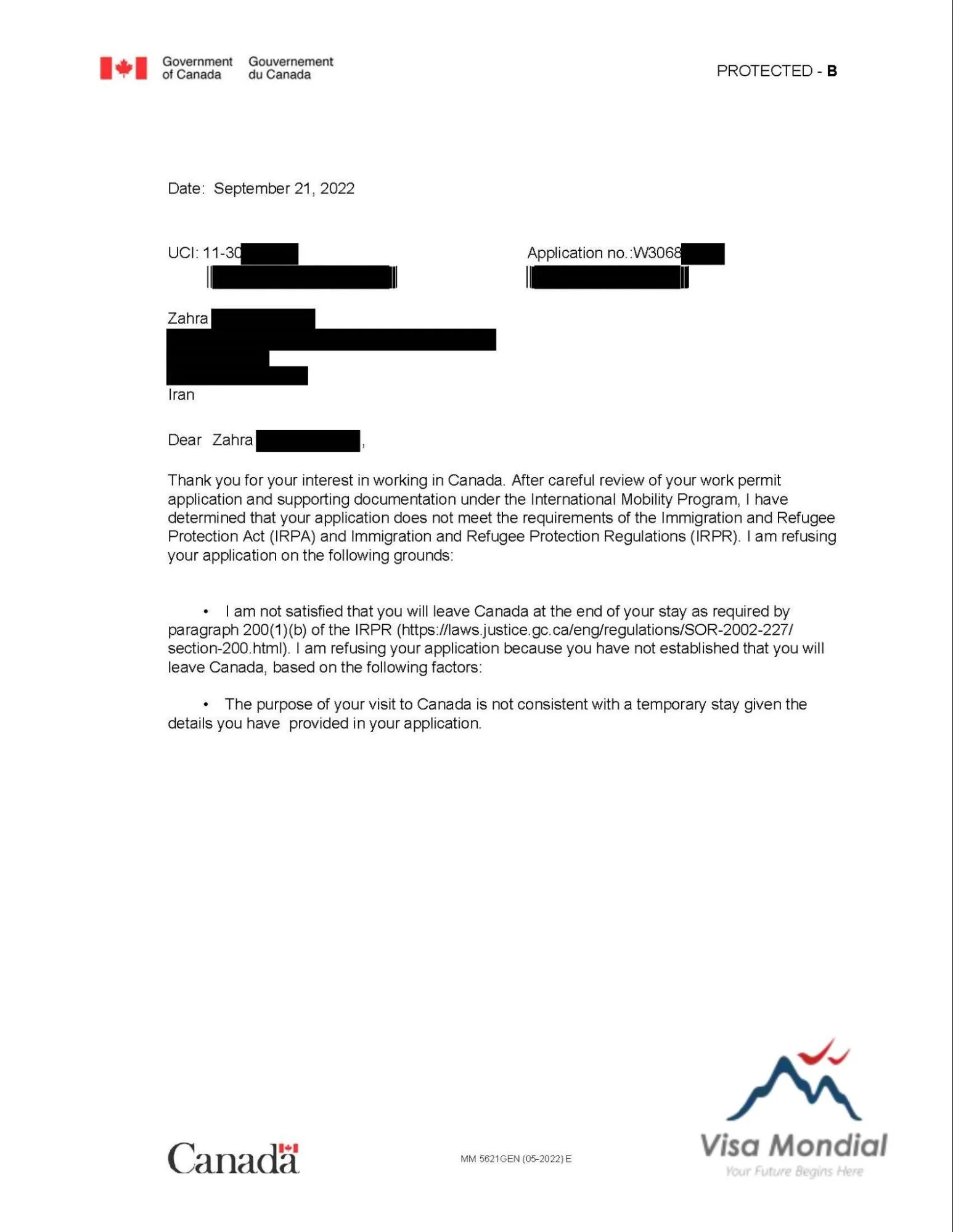
When your visa application is refused, you’ll receive a “Visa Refusal Letter” from IRCC, explaining the reasons for the decision and outlining the next steps.
However, the letter might not clearly state the specific reasons for your application’s refusal. To get exact details, you can apply for GCMS notes (Global Case Management System notes).
Student Visa Refusal Letter Sample

Visitor Visa Refusal Letter Sample

Work Visa Refusal Letter Sample
Canada Visa Refusal Rate
Top 10 Canada Visa Refusal Reasons + Fixes
Understanding the reasons for your Canada visa rejection is crucial for addressing them effectively and taking the right approach on your next attempt. Below are the most common reasons for Canada visa refusals across different visa types.
1. Unclear or Unreasonable Purpose of Visit
An unclear or unreasonable purpose of visit is one of the most common Canada visa rejection reasons. If your refusal letter includes statements like these, it likely means your application was refused due to issues with the “Purpose of Visit”:
- “The purpose of your visit to Canada is not consistent with a temporary stay given the details you have provided in your application.”
- “I am not satisfied that you will leave Canada at the end of your stay as required by paragraph 200(1)(b) of the IRPR.”
When your refusal letter includes these statements, it means you haven’t fully convinced the officer of your intention to leave Canada at the end of your stay.
Solution
- Make sure your application clearly explains why you are traveling to Canada and why you’ll return home. This way you can easily avoid such Canada visa refusal reasons.
- Clearly state your reason for visiting and how it fits your personal or professional situation.
- Show strong ties to your home country — like a job, family, property, or studies.
- Include documents that support the purpose of your trip (e.g. employer letters, event invitations).
- Make sure your background aligns with your stated purpose.
- Add a detailed travel itinerary with dates, accommodations, and planned activities.
- Attach flight and hotel bookings, even if refundable.
- If invited, include the invitation letter and financial proof from the host.
- Your goal is to show that your visit is logical, temporary, and well-documented.
2. Family Ties
Family ties, whether weak ties to your home country or strong ties to Canada, are among common Canada visa refusal reasons. If rejected due to family ties, your refusal letter may include sentences similar to these:
- “I am not satisfied that you will leave Canada at the end of your stay, as stipulated in subsection 216 (1) of the IRPR, based on your family ties in Canada and in your country of residence.”
- “I am not satisfied that you will leave Canada at the end of your stay, as stipulated by subsection 200(1)(b) of the regulations, based on the following factor:
You do not have significant family ties outside Canada.”
These statements suggest you may have family members in Canada, or that you lack sufficient family ties in your country of residence—or sometimes, both.
- Refusal Due to Weak Family Ties to the Country of Residence
Having dependent family members, a considerable amount of investments, and property in your country of residence are some of the factors that can be considered as ties, which may indicate that you’ll return home after all.
If you don’t have such ties, the officer may conclude that you are less likely to return home at the end of your authorized stay in Canada.
- Refusal Due to Strong Family Ties to Canada
Having close family members in Canada can be a potential barrier to obtaining a visa, as immigration officials may assume that you intend to remain in Canada with your family once your visa expires.
Solution
- Submit evidence of employment in your home country, such as pay stubs and confirmation letters.
- Provide documents regarding family dependencies in your home country, such as children or parents you need to care for.
- Documents proving property ownership, such as lease agreements in your home country, can also serve as evidence of ties.
- If you have a family member who needs your care due to illness, obtain a medical certificate from their doctor explaining their condition and the necessity of your presence.
- Explain all your family ties in your Purpose of Travel letter, and ensure it is as comprehensive as possible.
- If you have any pets, include their Identity documents and mention them in your Purpose of Travel Letter or SOP.
3. Financial Status
Among Canada visa rejection reasons, financial status that is often highlighted in refusal letters in the following formats:
- “I am not satisfied that you will leave Canada at the end of your stay, as stipulated in subsection 216(1) of the IRPR, based on your personal assets and financial status.”
- “Pursuant to paragraph 220(a) of the IRPA [Immigration and Refugee Protection Act, RSC 2001, c 27], I am not satisfied that you have sufficient and available financial resources, without working in Canada, to pay the tuition fees for the course or progra of studies that you intend to pursue.”
- “Your assets and financial situation are insufficient to support the stated purpose of travel for yourself (and any accompanying family member(s), if applicable).”
- “The compensation (monetary or other) indicated in your job offer and your assets and financial situation are insufficient to support the stated purpose of travel for yourself (and any accompanying family member(s), if applicable).”
Such refusal reasons demonstrate that you’ve failed to prove your ability to support your expenses during your stay in Canada. Not having enough budget, failing to submit sufficient documentation, and not including the source of your funds almost always result in Canada visa rejection.
It’s no secret that living costs are high in Canada, especially in major cities like Toronto or Vancouver. That’s why you need to show that you won’t be a burden on Canadian society and that you have enough money in your bank account to cover your living expenses.
Solution
- Include the source of your funds to show where you’ve obtained the money.
- Include bank statements and turnover documents for the past six months.
- Attach the documents related to any property or vehicles you own.
- If you have rental properties, attach the lease agreements to show that they are a source of income for you.
- If you are employed, include pay stubs for at least the past three months and an employment verification letter to demonstrate your financial stability.
- If someone is your financial sponsor, include their financial documents, pay stubs, and employment verification.
- Provide any additional documents proving you have financial stability and are able to cover your expenses.
Keep in mind that you’re showing the IRCC that you have the money available in case of an emergency, and you don’t have to spend it all!
4. Employment Situation
This rejection can be due to two factors:
- “current employment situation” or
- “lack of/limited employment prospects in your country of residence”
Sentences such as the ones below in your refusal letter indicate you’ve been refused for this reason:
- “I am not satisfied that you will leave Canada at the end of your stay as a temporary resident, as stipulated in paragraph 179(b) of the IRPR, based on your current employment situation.”
- “I am not satisfied that you will leave Canada at the end of your stay, as stipulated in subsection 216(1) of the IRPR, based on the limited employment prospects in your country of residence.”
- Limited Employment Prospects in the Country of Residence
This is usually connected to your plans after your visa expires and the employment prospects that motivate you to return home. When you don’t have any employment prospects in your home country, or if they are limited, you are more likely to stay in Canada.
You need to show that you already have employment opportunities in your home country once you return.
Solution
If your visa was refused due to “limited employment prospects in your country of residence,” your goal is to prove that you have a clear, realistic, and promising career path in your home country. Here’s how to strengthen your application:
- Show current or future job prospects with employer letters or proof of job opportunities. If possible, include an offer indicating your return date and your role upon return.
- Highlight the relevance of your skills or plans to your local job market. You can include labor market research, links to job postings, or government programs supporting your field.
- Clarify your career path and how your skills or experience are in demand at home — use job titles, responsibilities, or examples to support this.
- Explain employment gaps clearly and justify them with evidence (training, family responsibilities, etc.).
- If invited to work in Canada, make sure the offer outlines why you were selected, how your skills are needed, and how you’ll contribute to the company.
If you want to avoid such Canada visa refusal reasons, the key is to demonstrate that you are not seeking to migrate due to lack of opportunities, but rather you have strong career potential in your home country — and your visit to Canada fits into that path.
- Current Employment Situation
This relates to the stability or legitimacy of your current employment status. Your employment history will be reviewed by the IRCC officer to assess the consistency between payslips, payments, employment insurance history, and the stability of your work history along with your financial situation.
For example, if you’ve applied for a work permit, an immigration officer might reject your application under this category, indicating that:
“Your current employment situation does not show that you are financially established.”
While the grounds for refusal are still financial, the issue lies with your employment situation or your wage.
Solution
- Provide a clear and credible picture of your professional status and future plans.
- Provide proof of employment, such as job letters, recent paystubs, or employment certificates.
- If unemployed, explain your situation and show how your future plans will improve your career prospects at home.
- Clarify any employment gaps with reasonable justifications (e.g. further education, caregiving, relocation).
- If you have a job to return to, include a letter stating your return date and duties, showing your role is active and ongoing.
- When applicable, include job offers (whether in your home country or abroad), and make sure they’re detailed and verifiable.
- Show alignment between your background and future goals, especially if your education or experience supports your career trajectory.
The key is to present yourself as someone with stable, realistic employment prospects and no intent to overstay in Canada due to lack of opportunities at home. This way, you can avoid such Canada visa refusal reasons.
5. Establishment
Rejection in the category of establishment relates to how established you are in your country of residence. It can encompass various reasons collectively described as “not reasonable”.
These reasons can include your qualifications, previous studies, missing mark sheets, academic record, level of establishment, language abilities, financial ability, ties to your home country, and/or future plans.
In other words, all your ties in your country of residence can be considered part of your level of establishment.
In the case notes below from different applicants, the officer mentioned rejection due to establishment:
- The PA’s proposed studies were “not reasonable in light of one or more of your qualifications, previous studies, employment, level of establishment, other educational opportunities available in Canada, language abilities, or your future prospects and plans.”
- “The applicant does not appear to be sufficiently well established that the proposed travel would be a reasonable expense.”
6. Travel History
Although it is a factor that should be considered neutral, lacking a strong travel history can sometimes be used as grounds for Canada visa refusal, especially among Canada visitor visa refusal reasons. This usually relates to push and pull factors. People without a strong travel history are less likely to leave Canada once their permit expires.
Additionally, a history of overstaying your visa might result in Canada visa refusal.
- Mention all your previous international travels and indicate if there are any visa refusals or overstays in your travel history. Overstaying in any country could lead to Canada visa rejection; therefore, maintain a clean immigration record.
- Keep in mind that an incomplete or incorrect travel history might be considered withholding information, especially if you’ve been denied a visa.
Below are examples of such refusals in visa refusal letters:
- “… travel history is not sufficient to count as a positive factor.”
- “I am not satisfied that you will leave Canada at the end of your stay, as stipulated in subsection 216(1) of the IRPR, based on your travel history.”
- “I am not satisfied that you will leave Canada at the end of your stay, as stipulated in subsection 200(1) of the IRPR, based on your travel history.”
Solution
- Take one or two trips, especially to countries far from your hometown, to create a strong travel history.
- Accurately complete the travel history form, including the dates and duration of your travels, and don’t miss any international travel history.
- If you’ve been rejected for this reason, carefully read the visa officer’s notes to identify the problematic time periods.
- Mention all your visa rejections, if applicable, in your application.
- Make sure to inform IRCC about any history of overstaying a visa as well. Do Not Hide Any Information!
7. Misrepresentation
Misrepresentation is a serious offense in Canadian Immigration Law. If you provide misleading or false information, or withhold information-directly or indirectly-there will be legal consequences.
Misrepresentation can sometimes lead to deportation or a five-year ban from entering Canada.
- Fake Bank Account Documents
Fake bank account documents are considered a form of misrepresentation and can result in a five-year ban. The IRCC may verify the authenticity of your bank account documents with the issuing bank, and if you’ve submitted fake documents, there will be severe consequences.
Solution
- Ensure that the documents you submit are authentic and belong to you.
8. Errors in Documentation
When completing a visa application, you need to provide all the essential paperwork and supporting documents to prove your claims to the IRCC officers, especially regarding evidence of financial stability and qualifications related to the job applied for in work permit applications.
Additionally, all forms should be filled out correctly. Failing to do so or sending the wrong documents may result in the rejection or return of your visa application.
Solution
- Check all your forms and documents thoroughly before submitting to ensure everything is complete.
- Use a document checklist to double-check the final documents.
- Include any documents you think are necessary to support your case, even those that are not requested, if you believe they improve your chances of approval.
- If you forgot any document or if there are any updates on your information, submit a webform and inform the IRCC about the situation and attach the documents.
- Consider seeking the help of an immigration lawyer to prepare a solid visa application without any missing documents.
- Refused Vs. Returned
It’s important to understand that return is different from refusal.
| Visa Refusal Vs. Application Return | |
|---|---|
| Refusal | Return |
| In this case, refusal happens when you fail to provide documents. | Return may happen when there are missing documents on your application or you’ve filled out forms incorrectly or there are missing signatures. |
Sometimes, when your necessary documents are missing, your application will be put on hold, and the IRCC will reach out to you to request the missing documents. In such cases, you need to respond as quickly as possible to enable the application process to continue.
9. Immigration Status in the Country of Residence
Texts such as the one below in your refusal letter can indicate that you’ve been rejected due to your immigration status:
“I am not satisfied that you will leave Canada at the end of your stay, as stipulated in subsection 216(1) of the IRPR, based on your immigration status in your country of residence.”
When submitting your application, you should be a legal resident of the country from which you are applying, or else you need to show that you are legally able to apply from that country. If you don’t provide such proof, you might be refused on those grounds.
Solution
- If you are in a foreign country where you are not considered a citizen, make sure you are not overstaying your current status.
- You should completely explain your current immigration status if you reside in a foreign country, ensuring that you have valid status.
- If you are on temporary residency, explain the exact date you arrived and the date you will exit the current country.
- Submit any relevant documents and all the supporting materials necessary to validate your current immigration status.
- You should substantiate any claims you make on your application with the appropriate documentation.
10. Inadmissibility
Sometimes, the refusal of your visa application happens on medical or criminal grounds.
Visa officers check your identification documents to ensure you don’t have any medical conditions or criminal convictions that would make you inadmissible to Canada.
If your medical exam shows that you have a serious illness that renders you inadmissible to Canada, your application will likely be refused. Additionally, if you have committed or been convicted of a crime, IRCC may refuse your study permit application.
Solution
- Undergo any required medical examinations to provide proof to IRCC regarding health-related matters.
- Include your medical history documentations, such as vaccination records.
- Provide a letter from a certified healthcare professional confirming your health status.
- If you have a criminal record, be transparent about it and submit the necessary documents, such as evidence of rehabilitation efforts, and so on.
What Should I Do After Receiving a Canada Visa Refusal?
It can be upsetting and frustrating to receive a Canada visa refusal from IRCC, but there’s still hope. First, you need to understand the grounds for your refusal:
- Carefully read the refusal letter
- Request officer’s notes (GCMS Notes) by submitting an ATIP request.
- Then analyze the detailed case notes written by the immigration officer to determine the best approach for proceeding with your immigration journey.
- It’s highly advisable to seek expert assistance at this step to help prevent another visa refusal in your immigration history.
After analyzing the officer’s notes, based on the reasons of your visa refusal, you have three approaches to consider:
- Reconsideration
One option is to submit a request for reconsideration. If IRCC decides review your reconsideration request, the same officer who initially examined your application will reassess it.
You should request reconsideration for a Canada visa refusal if you believe you were wrongfully refused.
Read more: reconsideration request IRCC
- Judicial Review
If you believe your Canada visa refusal was unreasonable, unfair, or contains factual errors, you may be eligible to file a case with the Federal Court of Canada and request a judicial review.
If the judge finds your claims eligible for judicial review, they will grant you “leave” and you can attend a hearing to defend your case.
If you win, your application will be reassessed as a newly submitted application by a different immigration officer.
Read more: How to Appeal a Canada Visa Refusal
- Resubmit or Reapply
For those wondering “If my visa is rejected can i apply again?”, there is a bright spot: After receiving a Canada visa rejection, you can submit a new application with updated and stronger documentation and a more compelling case to improve your chance of approval.
Choose this option if you believe the grounds for refusal were valid and you can add new documentation or updated information to address the current refusal issues and strengthen your application.
Case Studies
1. Unclear or Unreasonable Purpose of Visit
Visa Mondial to the Rescue: Farzaneh’s Final Refusal
- Visa Type: Visitor Visa
- Refusal: 3 refusals in the immigration history, 2022, 2021, 2019
- Refusal Reasons:
1. The purpose of visit does not appear reasonable given the applicant’s socio-economic situation and therefore I am not satisfied that the applicant would leave Canada at the end of the period of authorized stay.
2. Taking the applicant’s purpose of visit into account, the documentation provided in support of the applicant’s financial situation does not demonstrate that the applicant is sufficiently established that the proposed visit would be a reasonable expense. - Date of start with Visa Mondial: 29.10.2023
- Result: Approved
- Date of approval: 24.02.2024
Rejection after rejection… Farzaneh couldn’t stand receiving another visa refusal; her Canada visa had been rejected 3 times already.
5 years ago, her whole family, including her husband and daughter, used her sister’s invitation letter to apply for a Canada Visitor Visa but received a refusal in return.
3 years ago, she applied with her daughter, and another refusal was added to her immigration history.
And 2 years ago, she applied alone. This time, the refusal was due to her financial situation and the purpose of the visit.
With shaking hands and a heartache from the constant refusals, she turned to Visa Mondial for help.
- October 29, 2023
After reviewing her immigration history and previous applications, we decided that she should resubmit a better and stronger application. So, we rolled up our sleeves and started preparing her an amazing application filled with solid documents, which we then submitted.
- February 24, 2024
After a few months, we were able to share the good news with Farzaneh: her visa was approved after three rejections!
2. Family Ties
Visa Mondial to the Rescue: Mina’s Family; a Rejection and Approval Story
- Visa Type: Student Visa
- Refusal: January 20, 2024
- Refusal Reasons: The applicant does not have significant family ties outside Canada.
- Date of filing in the Federal Court: March 20, 2024
- Result: Settlement
- Date of settlement: May 28, 2024
- Approval after Settlement
- Date of Approval: August 06, 2024
Mina is a 40-year-old married woman with a daughter. Dreaming of studying in Canada, she received an acceptance from the University of Windsor.
After receiving her letter of acceptance, she decided to apply for a study permit and take her husband and her daughter with her to Canada as well.
- January 20, 2024
Sadly, on the 20th of January, her student visa application was rejected due to not having significant family ties outside of Canada.
She booked an appointment with Visa Mondial, and we decided to take her case to the Federal Court of Canada since there was clear evidence related to her family ties to the home country in her application, and it had a high chance of winning.
- March 20, 2024
We filed the case with the Federal Court of Canada on the 20th of March. Wrote a strong legal argument and submitted it a few days later.
- May 28, 2024
With a bit of luck and a lot of effort, we received an offer of settlement from IRCC a month later on May 28. The application, then, went back to IRCC for reassessment by another immigration officer.
- August 06, 2024
We were so excited to call Mina’s family and tell them they could pack their bags and get ready for their trip to Canada because they had been successful this time and received approval on August 06, 2024.
3. Financial Status
Visa Mondial to the Rescue: Meysam’s New Beginning
- Visa Type: Student Visa
- Refusal: September 25, 2023
- Refusal Reasons: Insufficient fund
- Date of Filing in the Federal Court: February 15, 2024
- Result: Settlement
- Date of Settlement: March 19, 2024
Meysam who was only 19 years old took the student visa rejection hard. He applied for a study permit to study at George Brown College of Applied Arts and Technology. But fate seemed to have other plans for him when he received a refusal letter.
- September 25, 2023
Meysam received his Canada visa rejection letter on the 25th of September. The immigration officer questioned Meysam’s financial stability. Despite the towering evidence of his family’s wealth, the lack of a six-month transaction history cast a long shadow.
Meysam didn’t know what to do… He searched online and realized he had three choices: resubmit, request reconsideration, or a judicial review.. he didn’t know which way to go, and he needed legal advice. He remembered a friend of his father once mentioned Visa Mondial when trying to proceed with his family’s immigration case.
- February 15, 2024
We delved deep into his case and analyzed the case notes line by line, fully noting the mentioned Canada visa refusal reasons. Highlighting Meysam’s family’s financial strength and providing strong supporting documents, we filed a case with the Federal Court on February 15, 2024.
- March 19, 2024
Result? On March 19, 2024, we received an offer of “settlement” from IRCC, overturning the initial visa rejection.
4. Establishment
Visa Mondial to the Rescue: Niki’s Story
- Visa Type: Student Visa
- Refusal: April 06, 2023
- Refusal Reasons: The client’s previous studies were in an unrelated field. The client’s previous employment and educational history demonstrate an inconsistent career progression.
- Date of Filing in the Federal Court: June 05, 2023
- Result: Settlement
- Date of Settlement: August 17, 2023
With a rejection on her immigration record and a scar on her heart, Niki turned to us for help. That’s how her story began with Visa Mondial.
Niki, a 40-year-old mother and Systems Software Support and Sales Strategy Analyst, considered immigrating to Canada to pursue her education with her son and husband. After crafting a strong application, she was accepted into Trinity Western University for an MBA.
She thought, “That’s it! I’ll have my study permit in no time with my LOA!” But fate had other plans…
- April 06, 2023
She will never forget this day for the rest of her life. The day she felt like her dreams were shattering into pieces.
Although she had previously earned a Bachelor’s degree in Software Engineering, and an MBA is considered an interdisciplinary major, her application was refused because her “previous studies were in an unrelated field.”
Despite her years of experience as a Systems Software Support and Sales Strategy Analyst, the letter also stated, “The client’s previous employment and educational history demonstrate an inconsistent career progression.”
She had to take action, so she turned to Visa Mondial for help.
- May 11, 2023
First, we listened to her story from day one until she sat in front of us. We felt her anger, disappointment, pressure, and uncertainty, having handled similar cases before.
Our next step was to assess her application thoroughly, identifying both its weaknesses and strengths.
Even the best applications can be refused for various reasons, so we analyzed the immigration officer’s notes to pinpoint flaws in the assessment. We believed she had a strong chance to win at the Federal Court of Canada.
- June 05, 2023
On June 5, we filed her case with the Federal Court of Canada to challenge the visa rejection. A few days later, we submitted our legal argument, emphasizing Niki’s solid academic background, her genuine intent to pursue further education, and the logical connection between her past employment, education, and her chosen program.
- August 17, 2023
Niki’s strong case, luck, and our compelling legal argument persuaded IRCC’s lawyer that Niki had a high chance of winning in Federal Court. They offered a “settlement” and returned the case to another immigration officer for reassessment.
We put a band-aid on Niki’s scar and a win on her history. Now she’s waiting for her case’s reassessment.
Visa Mondial to the Rescue: Kiavash’s Dream
- Visa Type: Student Visa
- Refusal: November 11, 2018 (out of Visa Mondial)
- Refusal Reasons: the applicant appears to have a moderate level of establishment in their country of residence, and as a consequence, this visit does not appear to be a reasonable expense.
- Date of start with Visa Mondial: 30.03.2023
- Result: Approved
- Date of Settlement: 21.12.2023
Kiavash was a knowledge seeker eager to study in Canada, fascinated by the level of education and the available technology there.
- November 11, 2018
He submitted a study permit application on his own but failed to craft a strong application. As a result, his study permit was rejected on November 11, 2018.
- March 30, 2023
Hearing about us from a friend, Kiavash decided to seek help from our experts to assess his application and proceed with his immigration journey. So, on March 30, we assessed his application and informed him that multiple areas needed strengthening before another attempt.
He agreed, gathered the required documents, and we crafted a stronger application, submitting another Student Visa Application for him.
- December 21, 2023
On December 21, 2023, the approval of his application came, making both Kiavash and us happy.
5. Travel History
Visa Mondial to the Rescue: Ups and downs
- Visa Type: Visitor Visa
- Refusal: October 27, 2023
- Refusal Reasons: The applicant’s travel history is not sufficient to count as a positive factor in my assessment
- Date of Filing in the Federal Court: March 04, 2024
- Result: Settlement
- Date of Settlement: March 08, 2024
- October 27, 2023
On October 27, Hamed became another victim of Canada visa rejection when he opened a refusal letter on his desktop.
He had applied for a Canada visitor visa to visit Vancouver. However, the officer refused his application, indicating that his travel history was not sufficient to count as a positive factor in his assessment.
Hearing that Visa Mondial has a 90% success rate in court, he decided to ask us for help with his student visa refusal.
- March 04, 2024
By assessing his application and analyzing his case notes to understand the Canada visa refusal reasons mentioned by the officer, we knew he could win an appeal in the Federal Court of Canada.
He had previously held two Schengen visas and traveled to Italy and Norway, as well as to Turkey and Thailand multiple times, which contributed to his strong travel history.
He also had strong family ties in his home country, including his parents and his brother.
So, we filed his case with the Federal Court on March 04, 2024, and submitted the legal arguments a few days later.
- March 08, 2024
Only 4 days later, Hamed’s case received an offer of settlement from IRCC, which was amazing since he was worried about the long processing time. Now, he’s happily waiting for the outcome of his reassessment by IRCC.
6. Errors in Documentation or Missing Documents
Visa Mondial to the Rescue: Mana’s Visa Challenge

- Visa Type: Student Visa
- Refusal: September 11, 2023
- Refusal Reasons: The applicant has not submitted enough supporting documents to satisfy me that the applicant has access to sufficient funds for this visit.
- Date of Filing in the Federal Court: November 09, 2023
- Result: Settlement
- Date of Settlement: July 05, 2024
Mana never thought she would be one of those who would receive a refusal letter. But many people have tasted the bitterness of a Canada visa refusal, and she was no different.
- September 11, 2023
On a hot summer day in Iran, Mana was anxiously waiting for news from IRCC about her study permit application for an MBA at Trinity Western University. Her husband and daughter also applied to accompany her.
Then, she heard the beep on her Gmail notification, and her heart raced as she refreshed her email for weeks, hoping for that approval.
What she found was a cold refusal letter, which felt like it was smirking at her. Panic and despair filled her, but she knew she had to stay strong and move forward with her immigration plans. After all, she had envisioned her future in Canada, and she was not one to give up easily.
Determined, she hopped online and booked a session with Visa Mondial.
- October 29, 2023
We reviewed her case as well as the officer’s notes. The reason for her rejection, as noted by the officer, was “The applicant has not submitted enough supporting documents to satisfy me that the applicant has access to sufficient funds for this visit.”
Mana has submitted the documents showing enough funds in her account and proof of 3 property assets. Unfortunately, she didn’t include any transaction history.
We decided to take his case to the Federal Court of Canada.
- November 09, 2023
On November 09, 2023, we filed a case with the Federal Court of Canada, challenging the visa rejection. In our legal argument, we emphasized Mana’s substantial financial resources and her ability to support her family during their stay in Canada.
Months passed, and Mana couldn’t help but stress over the result of the court procedure. She had high hopes but, at the same time, was filled with stress.
- July 05, 2024
One day, the phone rang, and all she could hear was the good news she’d been longing to hear: IRCC had offered a “settlement”. The well-deserved victory was Mana’s to take, and another immigration officer would assess her case as a new one.
We’re Here to Help…
With over 13 years of experience in the immigration field, particularly focused on immigration to Canada, we are here to guide and support you through your journey.
By giving you realistic consultation and sharing the knowledge we’ve gained over many years, we can help increase your chances of Canada visa approval.
We understand your frustration and know it can feel like the end of the world when you receive a Canada visa rejection. But you’re in safe hands with us. Rest assured, we will handle everything for you, and one day, you’ll wake up to the news you’ve been waiting for: Your visa has been approved!
"*" indicates required fields
FAQ
If my visa is rejected can I apply again?
Yes. You can apply as many times as needed to get your Canada visa approval. But keep in mind that you need to provide better and updated documents and a stronger application. Otherwise, reapplying will be useless.
Does U.S visa rejection affect Canada visa?
While it does not ensure a denial, it may raise worries among Canadian immigration officers. They may doubt your eligibility and intentions, especially if the reasons for the U.S. rejection match the Canadian immigration criteria.
When can I apply for Canada visa after rejection?
You can apply at any time once your visa is refused. There is no certain deadline for reapplying after Canada visa rejection. But do note that you should submit a better application.
How many times can you apply for Canada visa after rejection?
There are no limits to the amount of time you can reapply after receiving a refusal.
Who can bring a claim for judicial review to the federal court in Canada?
You, your immigration and Canada visa refusal lawyer, and anyone who is directly affected by the refusal decision can apply to the Federal Court of Canada for judicial review. If inside Canada, you have a 15 days deadline to file your application, if outside Canada, you have 60 days.
How long does it take to receive GCMS Notes?
30 days.
As of August 2024, there is a maximum 30 calendar days wait-time to receive your GCMS notes. In some circumstances, this period can last up to 60 days.
How much does it cost to order GCMS notes?
$5.00.
GCMS notes cost $5.00.
Can I get a visa after Canada visa refusal?
Yes, unless your refusal letter states that you can’t take further action.
How do I respond to a Canada visa refusal?
If your Canada visa application is refused, you have three options to proceed: Resubmit, Reconsideration, Request judicial review.
You can proceed with one of these choices and if done right, chances are you get your Canada visa.
Do I get a refund if my Canada visa is refused?
Your application fee for temporary resident applications won’t be refunded. In permanent resident applications, the right of permanent residence fee (RPRF) may be refunded when an application is withdrawn or refused.
Can I reapply after visa refusal?
Yes.
After receiving a Canada visa refusal letter, one of the options to proceed is to reapply. The other two are reconsideration or requesting a judicial review.
How soon can I reapply after a visa refusal?
Once you receive your refusal letter, you can reapply. But it’s wiser to reapply when you’ve reviewed and analyzed the officer’s note, updated your documents, and provided a stronger application with new information with a higher chance of visa approval.
How can I avoid Canadian visa rejection?
The most important thing is to create a strong document with a planned scenario. And you also need to have enough available funds to support your expenses during your travel. Another thing to consider is to provide the necessary and related supporting documents. Using the help of immigration consultants can also help you a lot since they know many useful tips and tricks to increase your chance of visa approval.
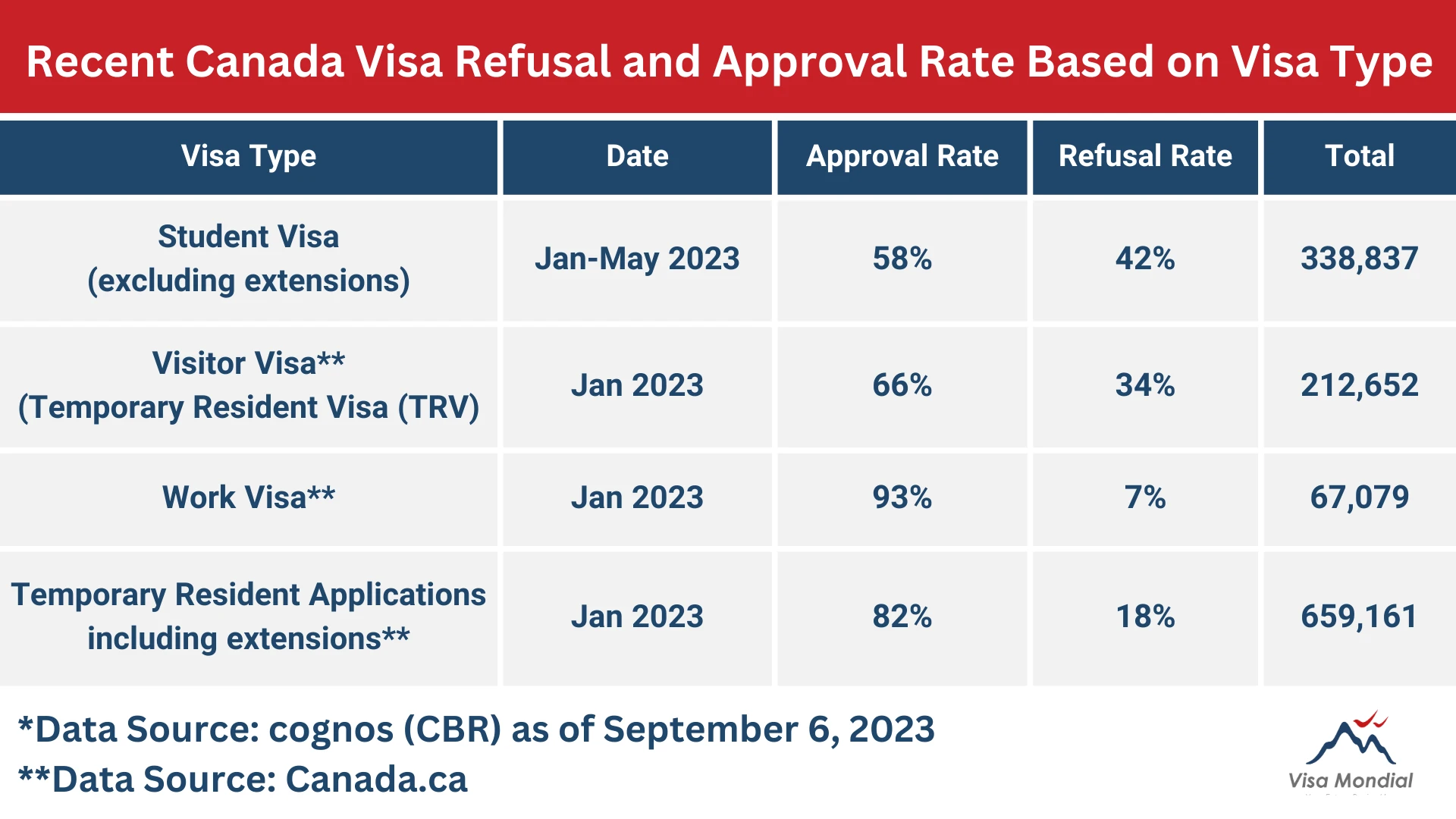
What is the refusal rate of Canada visa applications?
| Visa Type | Date | Refusal Rate |
|---|---|---|
| Student Visa (excluding extensions) | Jan – May 2023 | 42% |
| Visitor Visa (Temporary Resident Visa (TRV)) | Jan 2023 | 34% |
| Work Visa | Jan 2023 | 7% |
| Temporary Resident Applications including extensions | Jan 2023 | 18% |
Can I appeal for a Canada visa refusal?
Yes.
If you believe that the refusal decision was unfair, unreasonable, or had errors in following laws or facts, you can appeal the decision to the Federal Court of Canada and request a judicial review.
Can I get a Canada visa after 3 refusals?
Yes. It is still possible, but only if you follow the correct approach to address the refusal.
We had cases with more than 5 refusals who finally succeeded in receiving their approval.
Does Canada visa refusal affect Canada PR?
No. but you should mention your refusal history (if any). You should mention the rejection date and the visa type you were rejected for. Withholding such information counts as misrepresentation.
How long does a visa refusal stay on my record?
Canada visa refusal stays on your record indefinitely. But you can proceed with your immigration path by reapplying, resubmitting, or making an appeal to the federal court to try to obtain a Canada visa approval.
How many refusals are accepted in Canada when applying for a study permit?
Applying for a Canada study permit doesn’t have a maximum limiting number. You can apply as many times as you want after receiving a refusal letter.
How to appeal against a Canada visa refusal?
You can request a judicial review to the Federal Court of Canada by filing your claim. It’s important to hire an immigration lawyer that can ease the process for you.
What are my chances of success after an appeal?
Your chance of success after an appeal depends on your case and how strong you’ve defended your claim.
At Visa Mondial, we have taken more than 1,000 cases to the Federal Court of Canada and have an overall success rate of 90%.
What Should I Do After Receiving Canada Visa Refusal?
After carefully reviewing the grounds for your visa denial, you have three options: reapplying, requesting reconsideration, and filing an application for judicial review.
Can I get a Canada visa after refusal?
Of course there is a chance. You can reapply, request reconsideration, or appeal to the Federal Court of Canada based on your specific situation and try your luck for the second time.
How long does a Canadian embassy keep a record of a refused tourist visa?
A Canadian visitor visa refusal remains on your record forever. But you can try applying again. Be sure to explain why the previous refusal was wrong and provide any new information that might help your case.
How do I get help if my visa application is refused?
You can request your case notes to understand the grounds for your refusal. Then seek help from an authorized lawyer to consult your next steps, as to whether to reapply, request reconsideration, or appeal to the Federal Court of Canada.

